
- Log in to post comments
On the morning of 30 April 2026, a car rolled across the North-West University Potchefstroom Campus. No engine growl. No exhaust fume. Just a smooth, almost ghostly silence, and a whole lot of excitement.
Welcome to the age of hydrogen!
.png)
A Ribbon, A Plaque, and a New Era
The morning kicked off at Building N1, NWU's iconic Engineering Building, where dignitaries gathered for a briefing before making their way to the newly completed Rapid Prototype Training and Testing Facility (Building N6). Then came the moment everyone had been waiting for: the cutting of the ribbon.
As the fabric fell and the plaque was unveiled, it was a declaration. A declaration that South Africa's hydrogen future has a home, and that home is right here at the North-West University.

The Car That Runs on Water Vapour
After the ribbon-cutting and facility tour, the crowd moved outside for the main spectacle: the handover of the Mobile Hydrogen Refuelling Station to Toyota South Africa Motors, and a live demonstration featuring the Toyota Mirai, a hydrogen fuel cell electric vehicle.
The HySA Infrastructure team fired up the refuelling station, connected it to the Mirai, and filled its hydrogen tanks right there on campus. Then came the demo drive.
Here's what struck everyone: silence. Pure, eerie, wonderful silence. No combustion. No roar. The Toyota Mirai glided forward with nothing but a soft electronic hum, and the only thing coming out of its exhaust pipe was water vapour. Students who had studied thermodynamics and electrochemistry in lecture halls were now watching those equations drive past them in real life.
How does it work? A hydrogen fuel cell vehicle like the Mirai stores hydrogen gas in high-pressure tanks. That hydrogen is fed into a fuel cell stack where it combines with oxygen from the air, generating electricity to power the motor, with water as the only by-product. No combustion. No carbon dioxide. Just clean, quiet motion.
Behind the Technology: HySA at NWU
This isn't NWU's first rodeo with hydrogen. The university co-hosts the HySA Infrastructure Centre of Competence, South Africa's national flagship hydrogen research programme, alongside the CSIR. The Centre, directed by Prof. Dmitri Bessarabov, focuses on hydrogen production, storage, and delivery technologies. The Mobile Hydrogen Refuelling Station was completed in February 2025, through a partnership between the HySA Infrastructure Centre of Competence and Toyota South Africa Motors, and its handover marks a significant milestone in South Africa's Just Energy Transition journey.
The overall vision of the HySA programme is to bring about wealth, jobs, and intellectual property rights creation through the initiation of new high-technology industries based on minerals found on South African soil, especially platinum-group metals, allied to the goal of developing cost-competitive solutions for generating hydrogen locally using renewable energy.
In plain language? South Africa sits on massive platinum reserves. Platinum is a key material in hydrogen fuel cells. NWU's researchers are turning that natural advantage into global-grade clean energy technology, and creating skilled jobs in the process.
The Room Was Full of the Right People
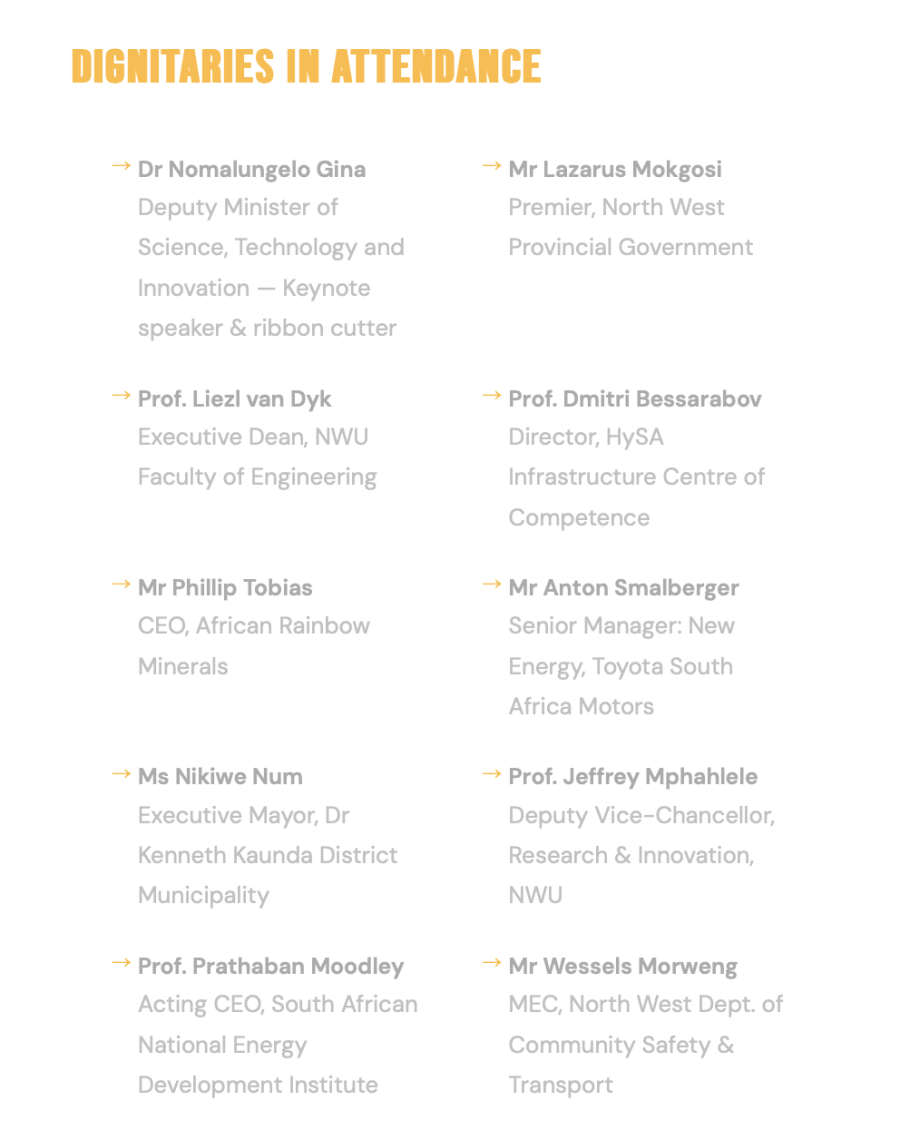
The presence of government, industry, and academia under one roof, on a university campus, sent a powerful message: South Africa's hydrogen economy is a people project, and it's being built right here, in lecture halls, labs, and parking bays in Potchefstroom.
What This Means for You. Yes, You!
If you're a matric learner wondering which university to choose, or a Grade 11 student trying to figure out what to study, today's event at NWU was a live demonstration of the kind of future you could be part of.
The NWU Faculty of Engineering continually strives to be a training hub for high-quality, versatile and innovative engineers. With four schools spanning Chemical & Minerals Engineering, Electrical, Electronic & Computer Engineering, Mechanical & Nuclear Engineering, and Industrial Engineering, the Faculty of Engineering offers seven undergraduate programmes, all accredited by the Engineering Council of South Africa (ECSA).
The HySA Infrastructure Centre of Competence is housed within that very faculty. The researchers who built the Mobile Hydrogen Refuelling Station are the same academics who teach students on this campus. That's not something you find everywhere.
The Theme Says It All
The official theme of the day was: "Placing science, technology, and innovation at the centre of government, education, society, and industry." It's a mouthful, but after watching a hydrogen-powered car silently glide across the Potchefstroom Campus while government ministers, mining CEOs, and university professors stood side by side watching, it didn't feel like a slogan. It felt like a description of what was actually happening.
South Africa has a huge role to play in the global green hydrogen economy. The platinum in the ground. The sunshine for green energy production. The research talent is being developed at institutions like NWU. Today, all of that came together in a single morning, and it was extraordinary.
Want to Be Part of What's Next?
Explore engineering at NWU, from hydrogen and clean energy to nuclear, electrical, and mechanical engineering.