
- Log in to post comments
We recently posed a simple question to our NWU LinkedIn community, and the answers were illuminating. With 375 responses and counting, the poll on thesis and dissertation writing processes paints a nuanced picture of postgraduate life at one of South Africa's leading research universities.

At first glance, the headline is encouraging: 44% of respondents describe their process as structured and planned. But look closer, and a richer story emerges — one that tells us a great deal about the support students need, and the cultures we need to build.
The numbers tell an honest story
That 44% lead a structured process is genuinely good news, but it means a majority of respondents don't. Nearly a third (31%) describe their process as a mix of structured work and reactive scrambling. A further 16% identify as the "what thesis?" cohort, those who haven't quite started, are paralysed by the enormity of the task, or are in the early fog of postgraduate study. And 9% admit to last-minute panic, perhaps the most relatable category of all.

Together, the 56% who are anything other than "structured" represent a real and addressable challenge. Not a failure, but an invitation to talk more honestly about what academic writing at this level actually demands, and what infrastructure NWU has in place to help.
Why structure matters more than momentum
In undergraduate study, many students learn to thrive on urgency. Deadlines create motivation; tight timelines produce results. But postgraduate research operates on a fundamentally different rhythm. A Master's dissertation or Doctoral thesis is not a single deliverable with a clear rubric; it is an evolving, multi-year intellectual project that requires sustained, self-directed focus.
Without structure, the sheer scope of a thesis can become overwhelming. Writers find themselves staring at blank documents, postponing chapters, or producing bursts of writing that don't cohere. NWU's thesis completion process recommends a chapter-by-chapter progression, with each section reviewed by the study leader before the next begins, a built-in structure that rewards incremental, deliberate work.
Planning is not the same as procrastination
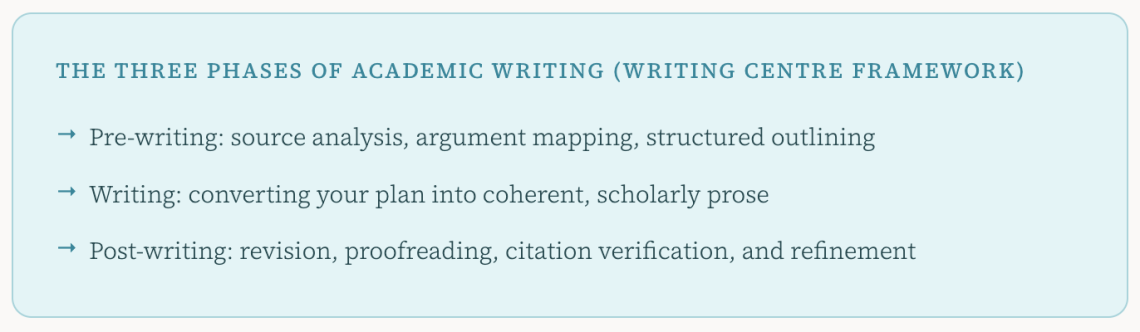
One of the most persistent myths in postgraduate culture is that sitting down to plan is somehow less productive than sitting down to write. In reality, the pre-writing phase, analysing sources, mapping arguments, and building an outline, is where the most important intellectual work happens. NWU's Writing Centre grounds its consultations in exactly this philosophy: writing is a three-phase process, and pre-writing is where clarity is built.
From panic to plan: the NWU support ecosystem
If you see yourself in that 56%, the good news is that you are not alone, and NWU has invested significantly in support structures designed for exactly this moment.

What the "mix" majority reveals
The 31% who describe themselves as "a mix of both" may actually represent the most important group in the poll. These are students who have structure in principle but drift into panic in practice, and that gap is often where dissertation progress stalls. The rhythm breaks, the weeks slip by, and before long, a chapter that was "almost done" has been sitting idle for a month.
For this group, the answer is rarely more motivation. It is almost always more accountability: regular supervisor meetings, peer writing groups, or even simply booking a regular Writing Centre slot to create an external rhythm. The Potchefstroom Campus Writing Laboratory specifically offers facilitated peer-to-peer group consultations and postgraduate writing workshops, structures designed to keep you in the work when the self-directed path gets lonely.
For the 16%: starting is the hardest part
To those who voted "what thesis?", this post is especially for you. Avoidance in postgraduate study is almost never laziness. It is usually overwhelming, uncertainty about expectations, or the quiet fear of producing work that isn't good enough. These are normal, human responses to an enormous task.
The NWU Library's Master and Doctoral General Orientation exists precisely for this starting point: it positions postgraduate students within the intellectual, regulatory, and research frameworks they need to begin with confidence. If you haven't attended one, register now. And if you're unsure where your thesis even begins, a Writing Centre consultation is a low-stakes, high-value first step.
A final thought
Postgraduate writing is rarely discussed honestly; the struggles are often hidden behind a performance of productivity. Polls like this create the permission to admit that the process is hard, uneven, and deeply human.
Structured doesn't mean perfect. It means intentional. It means choosing, each day, to move the work forward, one paragraph, one argument, one honest conversation with your supervisor at a time.
NWU is in your corner. Use the resources. Ask for help. And remember that every completed thesis in the NWU Repository was once a blank page.